The 2nd Workshop of the PLIGES Project Was Held
Shallow geothermal systems, i.e. those that use the heat of shallow layers of soil or underground and surface waters using heat pumps (in the ground to water and water to water versions) have a very large energy and economic potential. It is a solution for heating (and cooling) that enables cost reduction and, what is particularly important today, the use of completely green energy from the immediate surroundings.
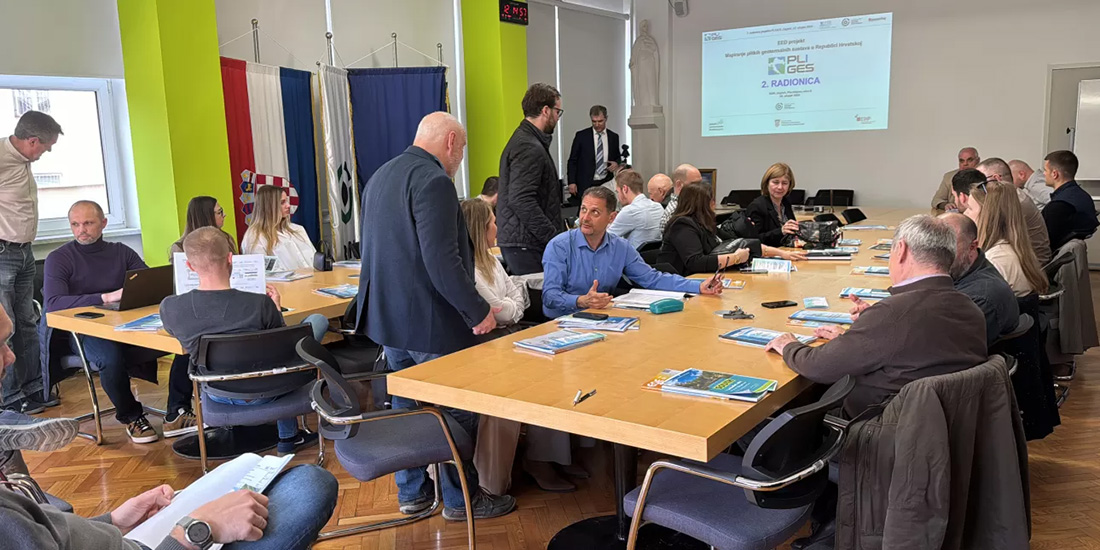
In order to bring the potential of shallow geothermal sources even closer to the professional public, the second workshop in a row of the project 'Mapping Shallow Geothermal Systems in the Republic of Croatia', or PLIGES for short, was held on 22 March. It is a project that brought together scientists, researchers and experts from two higher education institutions: the Faculty of Mechanical Engineering and Naval Architecture (FSB) and the Faculty of Mining, Geology and Petroleum Engineering (RGN) of the University of Zagreb and from the specialized company TT Inženjering from Zabok.
The goal of the project is to create a database and GIS map of the derived systems that exploit the heat of shallow geothermal sources. Why is there a good story behind all this? First of all, we are talking about energy from the immediate surroundings which is free and which can be relatively easily used for heating and cooling using heat pumps.
The Workshop started with a short address from the representative of the host, a RGN dean prof. dr. sc. Vladislav Brkić, who emphasized the importance of education in the field of mining, petroleum engineering and geology in the energy transition. The PLIGES project leader, prof. dr. sc. Vladimir Soldo from FSB shortly presented project, its implementation and achieved results, while dr. sc. Ana Kodba showed how a GIS interactive application of derived systems will look like. Dr. sc. Marija Macenić from RGN then highlighted the challenges that arise when designing large water to water heat pump systems and the case study of the future New Children's Hospital Blato in Zagreb.
Prof. dr. sc. Luka Perković from RGN was talking about field modeling of borehole heat exchangers under installation conditions in aquifers, while in the presentation given by doc. dr. sc. Luka Boban from FSB the experiences in designing water to water and ground to water heat pumps was given. In the last presentation at the Workshop, prof. dr. sc. Tomislav Kurevija from RGN showed the possibilities of regenerating a geothermal field by storing solar energy in the ground and whether solar borehole energy storage are profitable. Of course, the Workshop ended with a short discussion, during which it was noted that in all these works, where part of the underground aquifers are involved, care must be taken to protect them.
The third workshop of the PLIGES project was announced for the end of April 2024.