The Final Workshop of the PLIGES Project Was Held
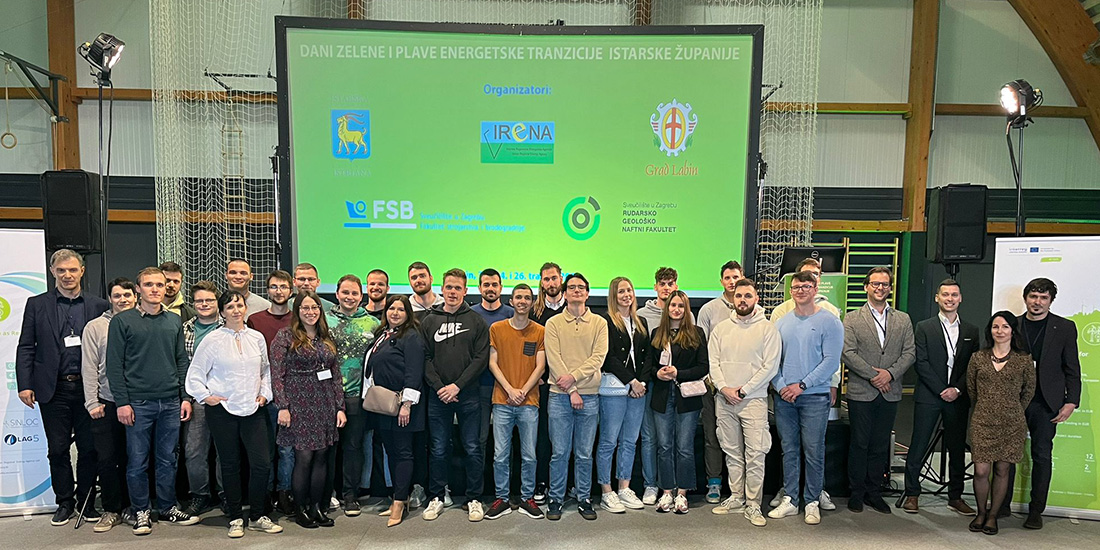
The extensive and interesting programme of the three-day conference under the common name 'Days of Green and Blue Energy Transition of the Istrian County' included, among other things, the final workshop of the project 'Mapping of Shallow Geothermal Systems in the Republic of Croatia' or PLIGES.
Under the common name 'Green and Blue Energy Transition Days of the Istrian County', a series of three-day events has been included with the aim of promoting the use of renewable energy sources and energy efficiency in Istria. The organizers of that meeting were the County of Istria, the Istrian Regional Energy Agency (IRENA), the City of Labin, the Faculty of Mechanical Engineering and Mechanical Engineering and the Faculty of Mining, Geology and Petroleum Engineering of the University of Zagreb.
The possibilities of applying solar and wind energy, geothermal and thermal energy of the sea were presented in detail, and special emphasis was placed on the Energy Sustainability Programme of the Istrian County. As part of this ambitious project, the construction of solar power plants with a total power of 400 MW and wind power plants with a total power of 600 MW is planned in Istria.
In the introductory part of the three-day conference, the mayor of Labin, Valter Glavičić, emphasized the importance of energy and power industry in the historical development of the city, while the deputy prefect of Istria, Tulio Demetlika, singled it out as one of the basic strategic goals of the county. The conference programme included presentations, discussions and workshops in which experts, scientists and researchers from IRENA, the Hrvoje Požar Energy Institute, the Faculty of Electrical Engineering and Computing of the University of Zagreb, the Green Energy Cooperative and the aforementioned FSB and RGN participated, as well as from other reputable companies and institutions.
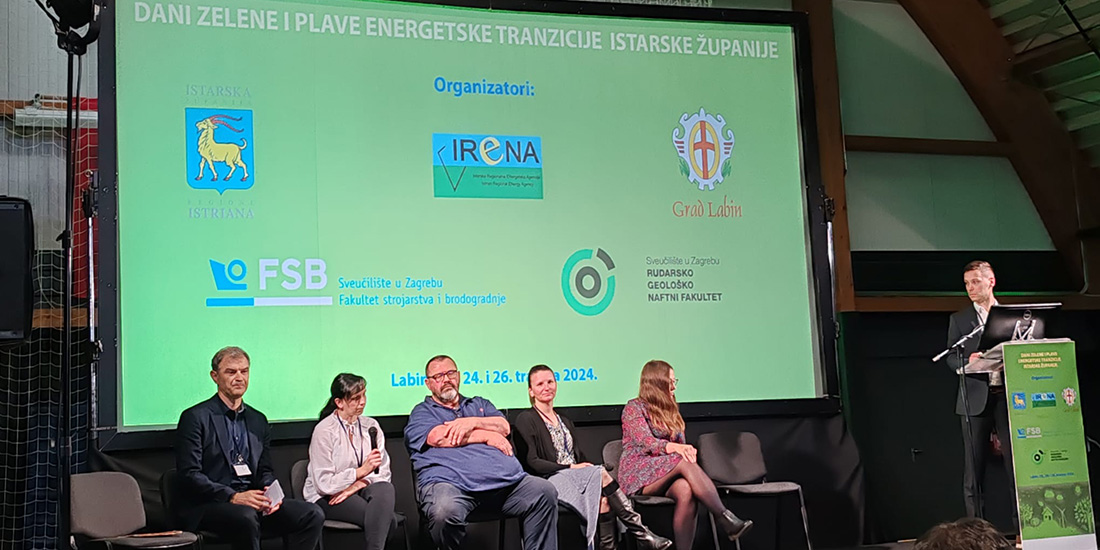
The extensive and interesting programme included, among other things, the final workshop of the project 'Mapping of Shallow Geothermal Systems in the Republic of Croatia' (PLIGES). This ambitious project was presented in detail, and then a shorter panel discussion was held in which prof. dr. sc. Vladimir Soldo, dr. sc. Luka Boban and dr. sc. Ana Kodba from FSB, dr. sc. Marija Macenić from RGN, Staša Borović, dipl. ing. from the Croatian Geological Institute and Ante Damjanović from the company Geoservis AS, specialized in drilling wells for heat pumps.
But that was not all on the topic of heat pumps. Namely, there was also a panel discussion entitled 'Using Thermal Energy of the Sea through Heat Pumps in Energy Renovation Projects of Buildings that Represent Cultural Heritage', short seminars on optimizing the heat pump system as part of the training program for designers and installers and on building the installation capacity of the use system thermal energy of the sea, intended for designers, installers, conservators, etc., and a workshop on the installation of a heat pump at the Mate Blažine High School.
The conference programme also included the workshop of the JETforCE Project, which included the installation of a fully functional solar power plant with a power of 8,1 kW on the roof of the Singles' Hotel.